Day Ten: Beetle Redux


There was a time in the United States when the Volkswagon Beetle seemed to be absolutely everywhere.  Driving down the street every third or fourth car was a Beetle, those little hump-backed alternatives to the gasoline guzzlers.  Indeed, no car had dominated its market niche the way the VW did for decades. But after OPEC and Middle Eastern politics forever ended America's banana boat innocence,  Toyota and the Japanese finally made it a fair game.  Still, for years, the Beetle seemed to have the entire small car market to itself.


After discontinuing the line in 1980 in the U.S., Volkswagon brought back the modern Beetle in 1998, a yuppier version of the old "get you here to there" model.  The modern replica has its own charm, but it has never dominated like its cheaper and less luxiourous cousin.  In the U.S., it is rare that you see the old Beetles nowadays.  Having almost disappeared, it has almost become an antique sighting when one is spotted.


But a trip to Mexico brings back the old days of the Beetle.  While they are not exactly every third car here, the old Beetles remain prominent.  This is in part because old cars hang around longer in Mexico.  This is a great place for viewing old Gremlins, Pacers and Pintos.  But more to the point, it is because production of the Beetle continued in Mexico long after the Beetles in the States were no more.  Mexican production of the older Beetles continued on until July 2003, when the last one was produced in Puebla, Mexico. 

A trip down any Guadalajara street should bring a Beetle sighting within a few minutes and bring back memories for any American car lover.

Day Nine: Red Light Runners

If we are to document some of the differences in Mexican and American daily life in these pages, it will be our unfortunate task to touch upon the precariousness of Guadalajara driving.  Today the subject is red-light running, and in all fairness, we must report that in Guadalajara, it is rampant.

First, a minor societal difference.  At traffic lights in this city, one receives an extra warning during the changeover to a red light --- the flashing green.  Traffic lights in Guadalajara proceed from green to flashing green to yellow and finally to red.  Still, the extra step that the government has provided does not seem to have tamed red-light running.  Because of this tendency, it is imperative that when sitting at an intersection when a red light turns green, to look both ways to make sure there are no late runners barreling through the intersection before making your move safely.

Unfortunately, safe driving here is not always entirely safe.  As the cautious driver approaches a fading yellow, they run a risk by not running the light.  The driver behind you is likely to expect the light to be run and may well step on the gas themselves.  A late stop on a changing light can result in the car behind you ending up in your back seat.  Similarly, in Guadalajara, one often sees the rather comical episode in which one cautious driver stops on a changing red only to have the car following, swerve around the first driver and run the light from the next lane over.

Careful out there, boys...


Day Eight: Delivery to Your Door? Not Just for Pizza

You wouldn't expect Mexico to be so big in the home "delivery" business.  After all, Mexicans are an incredibly industrious, gregarious people, rarely content to sit back and let life come to them.  But when it comes to fast food, perhaps they are.  Home-delivered food is huge here.

Of course, you would expect that American chains that operate in Guadalajara such as Domino's and Pizza Hut would have delivery service well-established.  And they do, along with other big pizza chains here and even small mom and pop pizza shops.  In fact, the typical guaranteed "30 minute or less" delivery time was the basis for an underrated 2004 comedy film from Mexico called Duck Season (Temporada de Patos).  Across culture, pizza delivered to your home is basic.
The smaller chains have motorcycle delivery to compete with the big boys. 

But in Mexico, you can get a lot more than just pizza delivered to your door.  Virtually every restaurant has a "servicio a domicilio" option, including those serving Mexican food, Chinese food, steak, even sushi.  Surprisngly, American chains who have never ventured into home-delivery in their homelands, have "domicilio" service here as well.  You can order a Subway 12-incher, KFC Popcorn Chicken or even a Flame-Broiled Whopper and be eating in front of your TV in a matter of minutes.  You can even order pharmacy prescriptions and have those delivered too.
Domino's has a strong presence in Guadalajara.

The bearers of these home-delivered meals are helmeted (and often uniformed) motorcycle drivers who zip about the city with small cubes attached to the rear ends of their bikes.  The food is kept hot in these boxes that are no more than the size of a footrest and usually hold the orders of just a customer or two.  The motorcycles move at a fantastic speed, often running red lights, cutting through lanes of traffic and weaving through stopped cars to get to their destinations within a half hour from the time the order was placed.

Indeed, while these motorcycles may make driving in Guadalajara a bit more precarious, at least you know that your pizza, or anything else that you care to eat, is going to arrive piping-hot.

Medicity allows you to order medications delivered to your door.

Day Seven: The Traffic Light Workers

In big cities in the United States there is often vocal opposition to those who beg for money. In the northeast cities of Washington DC, New York and Philadelphia, there are places downtown in which you can not walk more than a block without being asked for spare change.  Some Americans feel that those who beg should try to find useful work.  Whether or not this point of view has merit, these Americans would (or at least should) love the entrepreneureal spirit of the poor in Mexico.  While there are far more people who would qualify as the poorest of the poor, almost nobody actually begs in Mexico.


It is true that when you pull up to almost any traffic light along a main boulevard in Guadalajara, you'll find people asking for money.  However, the person asking is almost always ready to sell you something,  provide some sort of small service or even entertain you in exchange for your generosity.

These services fall along a continuum of usefulness  Some are really quite appreciated.  On a hot 110 degree Guadalajara day, no sight is more welcome than that of the man selling ice-cold water bottles at a downtown traffic light.  Similarly, the harried gentleman on his way to a date might well appreciate the vendor selling red roses at a traffic light along his route.  Other products available at your GDL traffic lights include fresh fruit, toys, bubble-makers, candy, lego sets, windshield wipers, car ornaments, roach-killers and just about anything else you can think of.

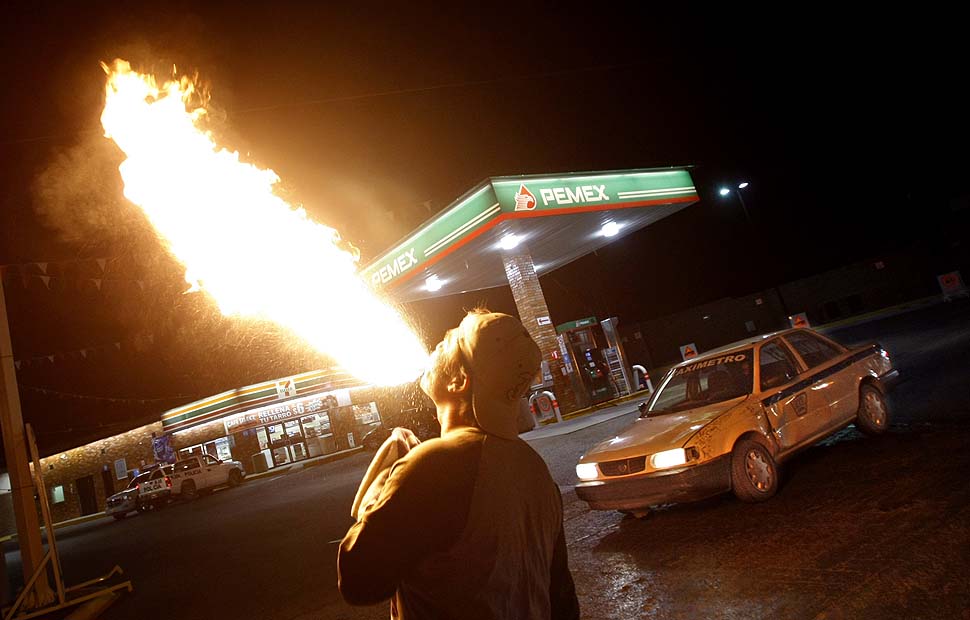
But there is another class of poor who cannot afford the initial purchases required for these such sales and are really just asking for your compassion.  The services they provide may not be particularly useful but their effort is appreciated by many.  These men, women and a surprising number of small children are often without decent shoes.  Most wear dirty clothing and sometimes are missing teeth or even limbs.  However, rather than simply beg, they try to do something to provide at least the semblance of an even exchange.  For instance, many will wash your windshield with soapy water and a rag --- a practice that has banned in many American cities, including New York City in 1992 .  Others actually do a small performance.  One man who works on Avenida Federalismo in Guadalajara dresses as a clown, carries a guitar and will sing a song of your choice.  At night, many men, and even a few women, do a fire-breathing performance that looks shockingly dangerous --- at least the first time you see it.  In the daytime, there are many jugglers who perform for the first minute of a traffic light cycle and then spend the last 30 seconds heading down the row of cars collecting donations.

Not that all Mexicans give or appreciate the spirit of the traffic light market.  There are a many rationalizations for not parting with one's pesos --- some reasonable, others less so.  Undoubtedly, some of those asking for money spend it on liquor or drugs.  Some traffic light workers collect for organized crime organizations who divert the money toward their own ends.  Giving to children can encourage their families to keep them out of school.

These reasons may be valid, however, any good free-market Republican would have to be appreciate the entrepreneurial spirit of those who piece together a living at Mexico's traffic lights.  They have found a way to turn major intersections into small free-market economies, making a couple minutes of lost time in a car into a chance to sell, service and entertain.

Day Six: Can I Help You?

The salesman in the United States has changed a great deal in the past half century.  Watch a few old movies and you often see a glimpse into the old salesman of year's past --- an overdressed, slick-haired, hyper friendly and smarmy gentleman ready to pull out all the stops to get you to buy his vacuum cleaner or toolset.  He was pushy, a master of smalltalk and a major-league nuisance.  In those days, salesmen (and occasionally saleswomen) even came right to your door.  During the 1970s and 80s, such individuals were largely put out of service in the United States.  The salesman and his routine still survive on the used car lots of autorows and perhaps in a few men's apparel stores, but generally when you enter a store in the U.S. these days, you are largely left in peace.

Of course, the flip side of this change is that you are now on your own when wandering through the empty chasms of modern stores like the Home Depot or Walmart.  Good luck finding a salesperson to point you to the section for plumbing supplies or home decoratating.  And with many employees working at a high turnover rate and at minimum wage without health benefits, they are not likely to give you the kind of personalized service of yesteryear.

But shopping in Mexico is a bit like a timewarp when it comes to customer service .  Many stores seem to "overhire" to the degree that there are more employees than customers.   For instance, if you visit a Guadalajara mall and enter a typical shoe store, clothing store or sporting goods store, you will likely find three or four employees waiting in expectation of the next customer.  Upon entering, you will be greeted by one of the employees and clearly "assigned" to that person.  The notion of entering a store and browsing on your own is more or less non-existent.  Of course, this does have its benefits.  The employee is usually ready to do anything under the sun to make your shoe apparel or clothing assessory dreams come true.  They are beyond helpful.

The reason companies are able to hire such a surplus of employees relates to the inexpensive cost of hiring workers at a minimum wage of just over 50 pesos per day.  In larger stores like Walmart or Home Depot (American behemoths that entered Mexico post-NAFTA), there is, of course, a less personal feel.  However, an abundance of workers still exist in such stores.  For instance, at supermarkets there are always nearly a dozen employees parading through the aisles with samples of mini-hot dogs, cheese with crackers and other assorted products.  At big box stores like Walmart, many employees hang out at the ends of each aisle ready to help you at a moment's notice.  In the pharmacy section, employees are there to help you find the exact toothbrush you are looking for or the correct flavored mouthwash.

It remains to be seen if customer service changes as Mexico continues into this new era of American franchises moving south of the border.  But for now the old style service of the helpful salesperson remains alive and well.

Day Five: Late Night Eats

A taco stand with a wide assortment of salsas and fixings.
Guadalajara is a city designed for the late-night eater.  While the U.S. may have Denny's and recently Taco Bell has started its "Fourth Meal" ad campaign to lure customers in sometime after dinner, Mexico is a comparative heaven when it comes to midnight snackers.  And actually midnight is not quite accurate...1, 2 even 3 AM is more like it.  This is the phenomenon of the late-night taco cart or puesto.  These carts are usually operated by two to four people and offer the very popular, very small Mexican-styled tacos.  A variety of meat are available usually including pastor, carnitas, chorizo and the like. Watching the cooking process is not for the faint of heart.  Usually some unfortunately large part of a former animal is waiting to be chopped by a man with a splattered apron and an usually large cleaver.
Customers standing and eating at a puesto.

You can find these taco carts almost anywhere.  They are often along main boulevards but due to the lack of zoning (or sometimes zoning enforcement) here in Guadalajara, they also operate in neighborhoods --- presumably keeping the neighbors awake.

The plethora of late-night customers is related to Mexico's later clock.  Because of the tradition of a long lunch hour where many school children and adults actually return home between 2 and 4, rush hour doesn't occur until 8:00 and night-lifers often don't begin their evenings until 9:00 or 10:00.  This sets the clock back considerably, and a late snack between midnight and 2AM is not uncommon.

These tacos are larger than typical but the red plates look familiar.
There are a few customs at the puestos which may seem a bit odd to Americans.  One is the tendency for Mexicans to stand while they eat.  Some taco stands have a few scattered tables and chairs ---and you can always find a spot on the curb --- but most Mexicans seem to prefer to stand. This can be a bit difficult if you have a drink in hand as well, but customers are quite expert at balancing their small plastic plates along with a beverage.  The plates themselves are usually red and plastic and covered with some kind of bag, almost like plastic wrap.  In this way, the owners can reuse the plates after throwing out the bag.  This saves money and is also (perhaps unintentionally) environmentally friendly.  One final custom is that taco eaters usually do not pay immediately.  Rather, the money exchange works a bit like at a sushi bar in which the owners hope you will keep asking for "one more" and adding to your bill.  When you are getting ready to leave that is when the final bill is tallied.
Some taco carts also bring along a few tables and chairs.

Taco stands remain extremely popular in Guadalajara even with the new preponderance of McDonalds, Burger Kings and KFCs.  While a Big Mac at 1AM is certainly tasty, the late night drive-thru pales in comparison to the character of your neighborhood taco stand.

Day Four: Trashing the City

Even designated trash areas often become unmanageable.

An unfortunate issue in Mexican public life is trash.  The truth is that is it is far too prevalent in places that it should not be.  The reasons for this are similar to Mexico's traffic problems.  The infrastructure is simply not organized enough to handle the problem.  In the case of garbage, there are not enough trash receptacles, recycle bins or closed-lid garbage bins.  And that's not even getting into the question of recycling.


This infrastructure issue leads people to throwing their trash any old place --- often in piles in parks or along the side of streets.  Even when trash receptacles are available, such as in some of the photos here, the system breaks down.

Many trash receptacles are not designed for all types of trash.
The lack of a solid garbage infrastructure also leads to unfortunate attitudes among the citizens. A kind of culture develops in which people do not think of public space as their own.  It is hard to buy into a system of responsibility when the system it is based on is clearly breaking down.  Thus, many citizens here attend to their own spaces fastidiously while letting public spaces go.  Individuals seem to have their own plots of space which they preserve intensely while anything outside is seen as a free-for-all.

This phenomenon is often seen in apartment buildings in Guadalajara.  You approach a building to find peeling paint, graffitied walls, weeds everywhere and a broken door.  Then you step into an apartment within the building and you find a beautifully decorated, well cared-for home.  It's as if anything beyond the line of the door frame doesn't count.
Unfortunately, nature and trash often go together in GDL.

The cultural difference here is unfortunate for Mexico.  While the United States is headed toward multiple choice composting options in most trash containers, Mexico seems to be lucky to have trash collected at all.  It will be interesting to see if cultural attitudes in Mexico force the government to do a better job with trash or if government action leads to a change in the attitude of citizens.  Or perhaps nothing will change at all...